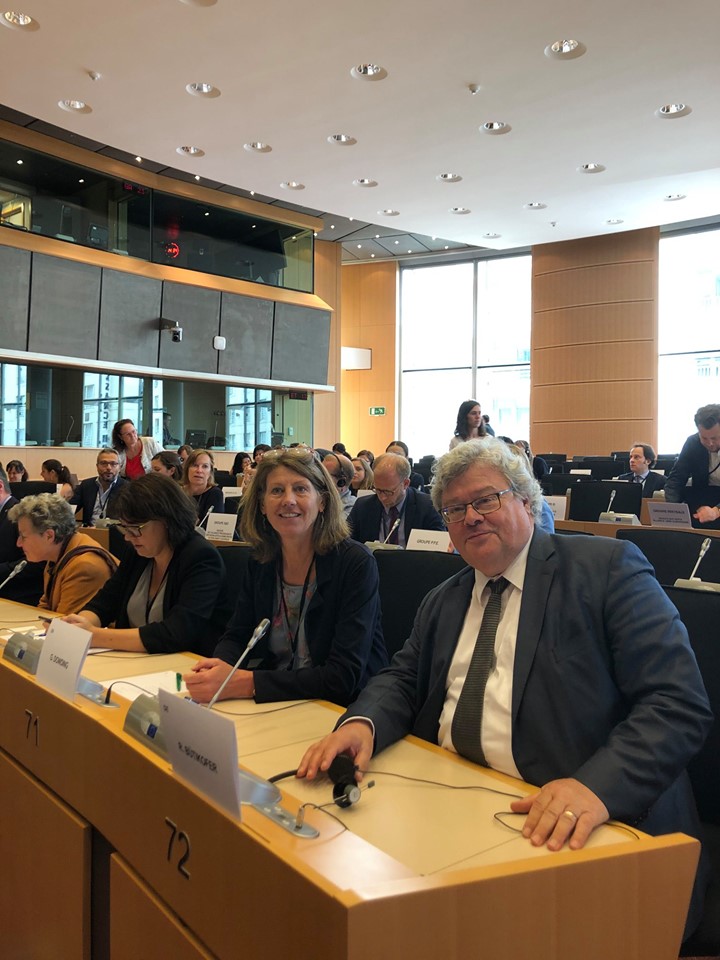
A week with pause to reflect on my time so far in the European Parliament; how it treats MEPs, why it treats us this way and the tools and systems at our disposal – some flawed, some vital.
There have been lots of firsts for me these past few weeks. It’s the first time that I have been elected as a Green to a level of Government higher than local council level. It’s the first time that I have travelled five separate times beyond the borders of Britain in seven weeks; thank goodness for the ease and speed of the Eurostar. It’s the first time I have had a budget to appoint staff to help with my duties as an elected representative; a huge relief to have researchers, administrative support and media help.
Last week’s first was an invitation to give an after dinner speech. This was to the Cumbria and North Lancashire ‘Forward in Europe’ group in Kendal. This group sprung from The European Movement, which has been in existence since 1947, founded after the end of the second world war and centred on fostering peace and cooperation with our European neighbours and partners. Never has there been a greater need for such an organisation. But since the 2016 referendum and before cross-party groups, grass-roots groups like theirs have sprung up all over the country. Ironically, the UK is now probably the most pro-EU country in Europe, with the greatest number of grass-roots groups striving to Remain.
I can’t begin to express my personal and professional excitement and joy at another first: being with so many senior elected representatives from the Green Party in one room. My first day in Brussels involved a meeting of the Green group of over 60 committed, competent, capable and experienced Green MEPs from all over Europe. One of my initial conversations was with Ville Niinistö, a new Finnish Green MEP, who until recently was Government Minister for the Environment in Finland.
In the UK we have Caroline Lucas who as an MP has set the bar high for what can be achieved through parliamentary and campaigning dedication. But due to fairer voting systems in nearly all other European countries, people are used to having Green representation in their national parliaments and indeed in Government.
During preparation for that after dinner speech, I had cause to reflect again about my first impressions of the European Parliament, and some of my first actions as an MEP:
The European Parliament building is modern; maybe some would describe it as post modern. It has masses of space huge ceilings, plenty of light, and a somewhat complicated architectural design internally making it quite difficult to get around. It took a couple of visits until I understood that there is no way to get from one end of the building to the other on all of the floors; there are 12 or more. It’s counter-intuitive to go up to come down but the best place to start is always the third floor!
There is huge a welcome given to MEPs; offices and allowances, assistance and services. This compares interestingly with the experience of Caroline Lucas as she has noted in various books that the welcome for a new MP in Westminster is a dreary office-cum-cupboard if you’re lucky, in a long dark corridor in the bowels of Westminster. Very little is provided: maybe a stack of of old letter-headed papers but above all, the pink ribbon for which MPs can hang their sword.
There is no doubt that MEPs however are treated as VIPs. This was a shock to the system for me, and although it’s something I’m adapting to because it’s the reality and I’m getting on with the work, the trappings and treatment do not sit easy. But as an elected representative of millions of people it’s important to take the role seriously and perform the duties assiduously. The perks, like an in-house medical service, are often more about ensuring MEPs time is used as as effectively as possible.
In Europe, there’s a sense of looking outward. The European Parliament expects and welcomes its activities to be scrutinised. There are media and recording facilities for all to use; the Vox Box corners that MEPs can book in order to film and publicise their activities, are where you will have seen some of my impromptu interviews with other MEPs. The tools available to us are excellent and it’s good to be able to reveal and hopefully demystify the work that goes on here. Last week the film makers said probably less than half MEPs are using the facility.
Much has been said about the cost of the European Parliament and there is definitely scope for efficiencies to be made. Like many other European countries where MPs are paid well, respected and provided with access to resources that enable greater efficiency, the European Parliament similarly offers a good working environment. The awareness of the stark disparity between optimal working conditions and typical ones, is uncomfortable but brings to light another issue that needs addressing.
Meanwhile this week…
Good:
Another interesting and ultimately satisfying process in the European Parliament worth highlighting: the commitment to gender equality enshrined already in some parts of the institutions. My first ‘constitutive’ meeting of the Foreign Affairs Committee, (that’s the first meeting whose business is only to appoint the Chair and the four Vice Chairs) was suspended when it became apparent that the political groups nominating people to specific roles (based across the board on proportional representation relative to size of the groups) had all nominated men to those five positions. After the election of the Chair and the first Vice Chair, the meeting was abandoned and those three groups now have to come up with at least one female nominee between them. The commitment to gender equality only goes so far that one of the five posts has to be a woman/man but still it’s there. I’m pleased to report that at the first constitutive meeting of the Transport Committee no such suspension was required. This is the committee for which the Greens get to nominate the chair and Karima Delli, Green MEP from Northern France is in the chair. She will be working with four Vice Chairs from other groups…all men.
Bad:
Despite the Government’s declaration of a Climate Emergency, they’ve done nothing to halt the progress of yet another fossil fuel source, shale gas. The Environment Agency this week put the health, well-being and future of a Lancashire community, in the hands of fracking firm Cuadrilla when they approved a second round of fracking near Blackpool. Operations had been stalled since October following 57 seismic events. This is the site I took direct action at, along with so many others since the protests started on 5th January 2017. Please do visit and lend support to those at Preston New Road if you can.
Where hope lies:
With climate emergencies declared this week in Burnley as well as Manchester, the message IS getting through; now for the hard work and scrutiny as we hold the Councils and Government to this commitment. It’s about getting started now; reinstating good public transport and halting the building of energy-inefficient homes. Green Party Councillor in Burnley, Andy Fewings who proposed the motion said: “This is not about paying lip service to protecting the environment. We need to see meaningful change in the council’s policies including supplementary planning guidance as lots of housing is not fit for purpose which is exacerbating fuel poverty.”
Onwards 💚