Ireland, Inundation & 12-Steps

This week afforded some free days and it was a joy to get over to Ireland to have much-valued family time; sadly I had to miss the Climate Action Bolton event but clashes of timetables couldn’t be corrected. I’ve also been getting on with planning; I decided early on that it would be important to have some tangible outcomes as a result of my first four months (whether or not that’s the only four months) in the European Parliament. With funds and resources available to MEPs that can contribute to our work here in the North West, I’ll be producing a report in October about the Green New Deal and what that means for our region.

It’s so encouraging to see councils up-and-down the country but also here in the North West declaring a ‘Climate Emergency’ and it’s vital to ensure that those calls result in fundamental changes in what local authorities do as providers of local services, in their procurement and practices, but also as community leaders. As a long-serving councillor, despite our media being dominated almost exclusively to the point being obsessed with national Government, I know it is in reality, local councils who have the ability to provide good leadership and to whom people relate in the first instance as their democratically elected representatives.

To this effect, our report will aim to be about “Responding to the Climate Emergency…turning a call for action into a plan. How a Green New Deal will address the social, economic and environmental crises in the North West”.

Climate Action Bolton

Early this week in my absence (but not without my input!) was the Climate Action Bolton meeting; lobbying Bolton Council to join seven other Greater Manchester Councils and declare a Climate Emergency. It’s 16-year-old Paris Hayes who is the driving force behind this. I wish I could have attended the “packed room with an impressive range of speakers” including Ali Abbas from Friends of the Earth, Lisa Nandy MP (Wigan), Dee Codd of Youth Strike 4 Climate Manchester and Extinction Rebellion and Astrid Johnson my Greater Manchester Liaison Officer.

Astrid said:

“It was a great meeting with an engaged audience and good questions that brought inspiring discussion. There was a spirit of co-operation along with collaboration; Lisa Nandy was very positive about the Green Party and Caroline Lucas in her speech. It was good to have Gina’s virtual presence and a pleasure to read her statement.”

My statement included:

“Today, I support in particular, the efforts of the Climate Action Bolton group and all interested parties that here today pressure Bolton Council to do the same. It is not only in Bolton that we are seeing our brave youth rise up to the challenge and demand that our political leaders take the climate crisis seriously – it is their future that is at risk. The youth climate strikes for example, have grown on a global scale and are simply inspiring: our young people are to be commended for taking a stand and we should hear them.”

Ireland

It was great to spend a few days accompanied by my son in Ireland this week visiting family. There’s a story -and a personally epic one in itself; although adopted, loved and brought up by Londoners, I have a wonderfully welcoming birth family (on both paternal-Protestant and maternal-Catholic sides) in the Republic of Ireland – discovered 21 years ago.

My birth father and half-sister are incredibly proud to have an MEP in the family, but bewildered and concerned about how Brexit is playing out on the island of Ireland. Sadly I don’t have any inside information or particularly greater insights than most who are following this. But I’m horrified to see the way that new Prime Minister Boris Johnson is seemingly trying to stir up trouble with the Irish Government and blame them for what is in effect, an impossible conundrum to solve. If Johnson gets what he wants- a hard Brexit – then that has to involve a border in Ireland between the EU in the south and the UK in the north. And no one of any political persuasion in Ireland wants that.

Meanwhile this week

Good:

I watched with deep concern as the news of the dam risk unfolded this week in Derbyshire and there’s more on the issues to consider around this below; the ‘good’ of it though is the efforts of the people who stepped up to help and offer kindness. The people of Whaley Bridge and surrounding areas acted from the best part of themselves in offering accommodation, toothbrushes, transportation, food and clothes to those who had left so quickly in the evacuation.

There were social media posts from mountain rescue teams thanking local businesses for providing food and rest for workers, a Muslim faith-based charity brought food to the school where many were evacuated to and countless other stories of human kindness that must have at least helped to ease immediate concerns. People at their finest.

Bad:

The awful situation for those 1,500 residents of Whaley Bridge who are still not able to return to their homes after they were evacuated due to life-threatening damage to a dam above the town. The Toddbrook Reservoir, like so much infrastructure, is just not designed for ever more extreme rainfall as the climate changes. I’ll be writing to the Environment Agency to ask what measures have been taken to increase the frequency of inspections and range of safety checks, taking into account changes in the way infrastructure like this behaves in a changing climate. A New Scientist article reports:

“Dams are typically designed to cope with a so-called 1-in-100-year flood event. But as the world warms the odds of extreme rainfall are changing, meaning the risk of failure is far greater.

“The 1-in-100-year event is perhaps happening every five years,” says Roderick Smith at Imperial College London. “I’m absolutely convinced that it is due to climate change.”

More here:

Where hope lies:

With the government and more than half of our councils having declared a ‘Climate Emergency’, the task now is how to react. Helpfully, the Association for Public Service Excellence (APSE) has been working with a number of authorities to support them with strategies, action plans and projects. Focusing on strategic and practical considerations, APSE Energy’s 12 points will help Councils to plan and act (full details in the link at the end):

  1. Leadership: the local authority has a duty of leadership

2. Strategy: a strategy to address a climate emergency

3. Capacity: enough political will to perpetuate an approach; human & financial resources

4. Action Plan & Projects: monitoring, reporting & reviewing

5. Targets & Data: setting a target date for carbon neutrality and monitoring targets

6. Finance & Risk: the skill is in prioritisation

7. Partners: the local authority has a responsibility to support businesses, employers, academic institutions, public services    & citizens to work towards reducing their emissions.

8. Suppliers: a local authority cannot have a climate-related target whilst ignoring the activities of its suppliers that have a duty to supply sustainably

9. Education & Culture Change: making a definite effort to put in place materials & resources that will educate in order to change behaviour

10. Innovation: invest in technology, deliver services and collaborate in new ways

11. Review & Inform: reviewing strategies and action plans to ensure outcomes

12. Behaviour Change: supporting people to change their eating, travelling & buying habits. Ensuring this agenda remains at the forefront of people’s minds.

Full information here.

Onwards 💚

*Image: Whaley Bridge, Sikh Sewa Organisation Manchester


PM, Pride & Priorities

No one can have got through this week with much of a sense of joy or optimism; the newly appointed Prime Minister and his Cabinet peppered with lobbyists and apologists have seen to that. Thankfully by the week’s end, I’d been lifted by news from Brussels that the European Investment Bank has proposed cutting support for energy infrastructure projects (fossil fuels). And then there was the glorious colour and solidarity on the streets of Liverpool at ‘Pride in Liverpool’ to refresh and renew for the week ahead.

Brussels

I took time to pause this week when I recorded a 50-second video of my priorities to go along with the 750 other MEPs who represent the 500 million people in Europe. Just outside the European Parliament in Brussels is the ‘Parlamentarium’, a visitor centre (a little like a planetarium or an aquarium but about the activities of the Parliament) and it has an interactive wall, with details about MEPs. From local councillor to being part of a European-wide visitor attraction in a matter of weeks is quite a strange feeling.

Also this week in Brussels, there was definitely a feeling of winding down: the parliament doesn’t exactly close, but there are no formal meetings during the next month and obviously many staff have their holidays.

I attended formal meetings of the Transport and Tourism committee. The committee is not yet dealing with any legislative business but instead is really in a kind of end-of-term-report period. There are what’s easiest to describe as ‘hearings’ taking place. I witnessed one with the outgoing Commissioners, and one looking forwards with the representatives of the new European Council. For the next six months Finland takes that role in the European Council, with Romania just finishing.

Yes it’s confusing for newcomers. I guess in a Union of 28 countries it’s bound to be but there’s certainly lots of chance to challenge!

Along with a number of MEPs (and not just from the Green MEPs group) we emphasised the need in transport for all interventions now to look to reduce emissions; and to look towards the earliest implementation of a kerosene tax on aviation industry. The latter is essential for reducing flights. Let’s not forget that 70% of all flights are made by just 15% of the population!

I am so pleased that I have been able to appoint a good team of staff. One of our first jobs is to get a website up and running for updates and easy contact. Until the site is live, please do find and share updates on one of these channels:

Twitter

Facebook

LinkedIn

I made a big commitment this week; to attend a cross-party delegation to Palestine and Israel. More on that soon.


Back in the North West – Love is Love

Fantastic, well organised and thoroughly enjoyed event – Pride in Liverpool; albeit a bit damp! There was rightly a party atmosphere and it was great to meet LGBT+ staff from the British Veterinary Association, the Home Office and organisers.

Although the focus was clearly on solidarity and celebration, PRIDE is a necessary protest still and there is awareness that with the changes in government and potential for Brexit, there comes a serious risk of losing hard won rights and freedoms for our LGBT+ communities.

When the European court of human rights ruled that gay men and lesbians could not be dismissed simply because of their sexual orientation, Ian Duncan Smith announced that once returned to power, if the Ministry of Defence wanted to retain the ban; a Conservative government would re-introduce it. Full article here.

Meanwhile this week…

Good:

Always good to think that some news has sent a shiver down the spine of the fossil fuel industry. This week the EU’s lending arm (European Investment Bank) drafted plans which propose cutting support for energy infrastructure projects which rely on oil, gas or coal by barring companies from applying for loans beyond the end of 2020.

From the media report:

“The EIB said its focus on long-term investments means that it must align with the Paris Agreement which aims to cap global heating at 1.5C above 1990 levels by cutting greenhouse gas emissions.

“This transition will be profound. Solidarity is required to ensure that potentially vulnerable groups or regions are supported,” the EIB report said.

“The lender said it will set up an energy transitions fund to support projects which help EU member states to transition to a cleaner economy.”

Full article here.

Bad:

Leading with typical bluster and bustle, Johnson has hit the ground out of step with reality and leading the country to a cliff edge clearly sign-posted ‘No Deal Brexit’. The new Leader of the Conservative Party and UK Prime Minister has shown outright contempt for the EU laws that protect us as consumers and workers, and his reckless threat to leave the EU without any arrangements in place, just demonstrates how irresponsible he is prepared to be.

It’s known that Johnson has a poor record on climate change (one of the most serious threats facing humanity) with his predisposition for fracking and having previously voted against setting a target for UK decarbonisation.

*I chatted with Scott Ainslie MEP in European Parliament about the former London Mayor becoming the new Prime Minister and how that might look: “Like a bad idea gone nationwide.”

Full video here

Where hope lies:

Hard to find this week but our Green MP Caroline Lucas always quick off the mark pointed out from Westminster: “…new Prime Minister Boris Johnson’s cabinet is the most right wing in years but Parliament is sovereign, he has no majority and we will fight his ‘No Deal Brexit’.”

If you’re not a member of the Green Party of England and Wales – please join and show where you stand on the environment and getting a say on our place in the EU.

Onwards 💚


Speeches, Motions & Marching

From making my first speech in the European Parliament plenary on clean air on Wednesday, to trying to get a motion again through Lancashire County Council calling for maintaining the current seismic limits at the fracking site, and ending the week in London at the REMAIN rally…it’s been a roller-coaster of a week: from first-time-highs to deep disappointments and anger, to being re-energised by the power and determination of those fighting to remain part of Europe.

Starting in Strasbourg, I spoke in a plenary session on the need for action on clean air; it was as daunting as it sounds -the space is so huge- but good to do. In the North West, over 2000 deaths per year are attributable to air pollution. I stressed the need for a shift to a truly green travel system with support for sustainable urban mobility plans; investment in cycling infrastructure, walking-friendly streets and public transport.

“With attractive sustainable transport and polluting vehicles off our streets, we can improve quality of life and save the lives of citizens across all of Europe.”

I watched a lot of the other speeches too and am in awe of the breadth of interests and strength of commitment by all the Greens; especially fellow UK MEPs. People might have noticed empty seats on the film-clips, as you would in any Parliament where people come for their specific interests rather than all the debates.

A lot was shared and discussed this week about Ursula von der Leyen as she successfully sought election to the role of President of the EU Commission, but with a margin of 9 votes; the Greens voted against her. Molly Scott Cato MEP sums up best why we did:

“The prospect of the first woman president of the EU Commission is a reason to welcome the nomination of Ursula von der Leyen. We are also encouraged by her comments on Brexit, particularly her willingness to grant the UK a further extension and so prevent a disastrous crash out of the EU. However, we find ourselves unable to vote for her.

“The appointments process used to select her was a back-room deal cobbled together to appease the far right in countries of Central Europe where the rule of law is under threat and democratic standards at risk. And on a wide range of issues, from tax and trade to climate and protecting life in our countryside, there is clearly a gulf between her views and the Green agenda for change.

“Had she chosen to set some targets for radical change that millions of Green voters demand, we could see the EU transformed over the next 5 years. We would tackle inequality and poverty, defend people from corporate power, fix our broken tax system and properly address the climate emergency.”

I came back to continue the debate in Lancashire County Council about fracking; particularly Cuadrilla’s shale gas site near Blackpool. I was left angered by the exchanges and the outcome. Drill or Drop reported:

“Conservative councillors in Lancashire have been accused of using a “wrecking amendment” for a second time to block support for their government’s policy on the rules on seismic activity induced by fracking.”

Conservatives councillors amended my motion, thus removing all reference to the traffic light system (that monitors seismic activity and forces a halt to fracking operations when seismicity goes above 0.5 on the local magnitude scale).

It’s very frustrating that local Tories are playing games with words: they have undermined an opportunity to strengthen the safety and protection for local people, and our calls for the fracking industry to be properly regulated when it comes to seismic limits.

The vote was 42 in favour of Conservative amendment, 34 against & one abstention.

I was atop a soapbox on Saturday and amongst an inspiring crowd as we took to the (London) streets to join the ‘March for Change’ alongside the ‘Another Europe is Possible’ contingent. I used the opportunity to call for people to visit the shale gas site near Blackpool and lend support to the residents who have been protesting there since 5th January 2017. I ended with:

I’ve got a message for the Tory no-dealers and fat cat fossil fuel industry:

This is our world

This is our Europe

This is our home

We will not be divided

We will work together

And together we will win climate and social justice


Meanwhile this week…

Good:

I went to the Electricity North West – Stakeholder Engagement Workshop and it proved very informative. Electricity North West (ENW) is the electricity distribution network operator for most of the North West. It owns and operates the network infrastructure (overhead lines, underground cables, substations etc) that transports electricity from the national grid to homes and businesses, and vice versa when energy is produced by domestic solar panels. And they’re vital to the low carbon transition. Unlike energy suppliers, network operators have an incentive to encourage consumers to use less energy (if we use less electricity, fewer infrastructure upgrades are needed!) and ENW plans to spend £63.5 million over the next four years to help businesses, customers and colleagues to decarbonise – check here for further information. It was good to hear their focus on protecting vulnerable customers from fuel poverty, which is a very real issue in the North West. In some wards, more than one in three households are in fuel poverty.

Bad:

Worrying news throughout the week as tensions are escalating in international waters with oil tankers being seized. The word COBRA sends shivers down my spine; this is the government’s alternate war cabinet when things get really serious. Such a shame it doesn’t meet regularly to deal with the climate emergency rather than focusing on the delivery of oil being transported around the world. The situation is deeply concerning but not unexpected after the ramped-up rhetoric and aggressive sanctions against Iran by the White House and the Trump withdrawal from Iran peace deal that was always going to have consequences.

Where hope lies:

An uplifting visit on Friday to the British Muslim Heritage Centre in Manchester and meeting with the Chair, Nasar Mahmood OBE and Chief Executive, Maqsood Ahmad OBE. The commitment and ambition of the staff and Trustees to providing open, welcoming facilities not only for the Muslim community, but for a whole range of diverse communities to work and learn together was inspiring. The venue itself is in a beautiful setting. There are two exhibition spaces: House of Wisdom, and Stories of Sacrifice, which is dedicated to the bravery and sacrifice of hundreds of thousands of Muslim soldiers who fought for Britain in World War One, provide such good information on the contribution Muslim communities have made to science, technology and culture. The conference space, which is being expanded, is open for all groups to hire, creating jobs and community cohesion. Gracious hosts, a warm welcome and a real highlight of the week.

Onwards 💚


New President of European Commission

She won with 383. She needed 374.

Both the LibDem grouping (Renew Europe) and some of the Socialist and Democrat grouping voted for her. We’ve also been told that UK Labour MEPs voted for her – with such a small margin, they clinched it.

Ursula von der Leyen is now President of the European Commission. UK Green MEPs of Greens/EFA in the European Parliament made our statement about why we voted against her:

“The prospect of the first woman president of the EU Commission is a reason to welcome the nomination of Ursula von der Leyen. We are also encouraged by her comments on Brexit, particularly her willingness to grant the UK a further extension and so prevent a disastrous crash out of the EU.

“However, we find ourselves unable to vote for her. The appointments process used to select her was a backroom deal cobbled together to appease the far right in countries of Central Europe where the rule of law is under threat and democratic standards at risk.

“Also, on a wide range of issues, from tax and trade to climate and protecting life in our countryside, there is clearly a gulf between the views of von der Leyen and the Green agenda for change.

“If she becomes president, it will be thanks to the votes of the far right, rather than those of the strong pro-European majority. Had she chosen the radical change that millions of Green voters demand we could see the EU transformed over the next 5 years. We would tackle inequality and poverty, defend people from corporate power, fix our broken tax system and properly address the climate emergency.

“Improving the lives of citizens and restoring confidence in the EU is also the best way to crush the voices of nationalism, extremism & fascism that are gaining ground across the continent.”


Firsts, Perks & Purpose

A week with pause to reflect on my time so far in the European Parliament; how it treats MEPs, why it treats us this way and the tools and systems at our disposal – some flawed, some vital.

There have been lots of firsts for me these past few weeks. It’s the first time that I have been elected as a Green to a level of Government higher than local council level. It’s the first time that I have travelled five separate times beyond the borders of Britain in seven weeks; thank goodness for the ease and speed of the Eurostar. It’s the first time I have had a budget to appoint staff to help with my duties as an elected representative; a huge relief to have researchers, administrative support and media help.

Last week’s first was an invitation to give an after dinner speech. This was to the Cumbria and North Lancashire ‘Forward in Europe’ group in Kendal. This group sprung from The European Movement, which has been in existence since 1947, founded after the end of the second world war and centred on fostering peace and cooperation with our European neighbours and partners. Never has there been a greater need for such an organisation. But since the 2016 referendum and before cross-party groups, grass-roots groups like theirs have sprung up all over the country. Ironically, the UK is now probably the most pro-EU country in Europe, with the greatest number of grass-roots groups striving to Remain.

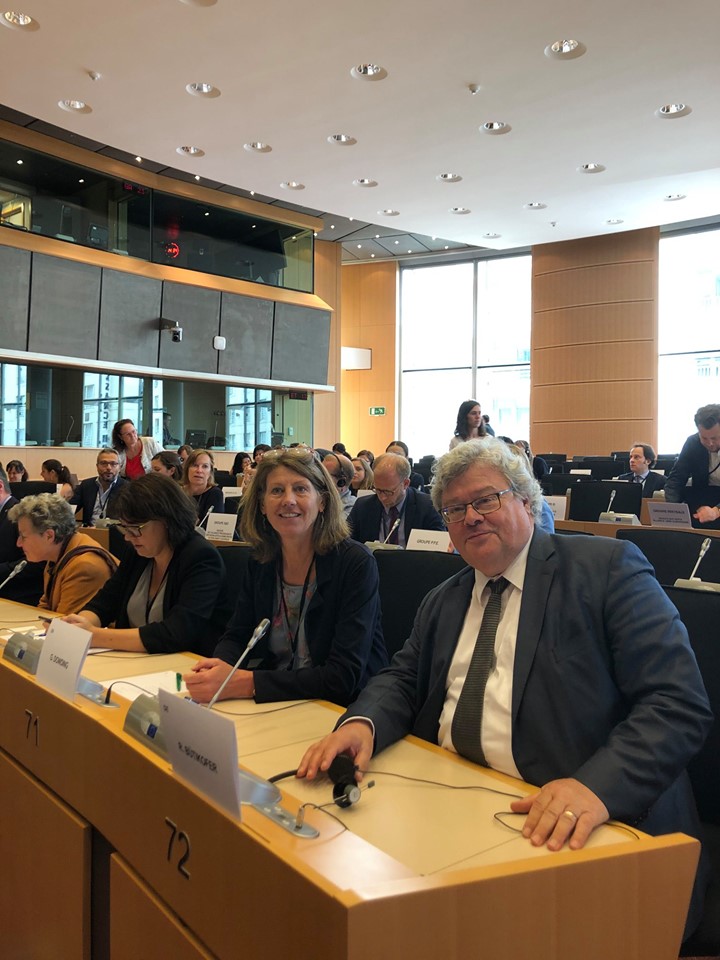
I can’t begin to express my personal and professional excitement and joy at another first: being with so many senior elected representatives from the Green Party in one room. My first day in Brussels involved a meeting of the Green group of over 60 committed, competent, capable and experienced Green MEPs from all over Europe. One of my initial conversations was with Ville Niinistö, a new Finnish Green MEP, who until recently was Government Minister for the Environment in Finland.

In the UK we have Caroline Lucas who as an MP has set the bar high for what can be achieved through parliamentary and campaigning dedication. But due to fairer voting systems in nearly all other European countries, people are used to having Green representation in their national parliaments and indeed in Government.

During preparation for that after dinner speech, I had cause to reflect again about my first impressions of the European Parliament, and some of my first actions as an MEP:

The European Parliament building is modern; maybe some would describe it as post modern. It has masses of space huge ceilings, plenty of light, and a somewhat complicated architectural design internally making it quite difficult to get around. It took a couple of visits until I understood that there is no way to get from one end of the building to the other on all of the floors; there are 12 or more. It’s counter-intuitive to go up to come down but the best place to start is always the third floor!

There is huge a welcome given to MEPs; offices and allowances, assistance and services. This compares interestingly with the experience of Caroline Lucas as she has noted in various books that the welcome for a new MP in Westminster is a dreary office-cum-cupboard if you’re lucky, in a long dark corridor in the bowels of Westminster. Very little is provided: maybe a stack of of old letter-headed papers but above all, the pink ribbon for which MPs can hang their sword.

There is no doubt that MEPs however are treated as VIPs. This was a shock to the system for me, and although it’s something I’m adapting to because it’s the reality and I’m getting on with the work, the trappings and treatment do not sit easy. But as an elected representative of millions of people it’s important to take the role seriously and perform the duties assiduously. The perks, like an in-house medical service, are often more about ensuring MEPs time is used as as effectively as possible.

In Europe, there’s a sense of looking outward. The European Parliament expects and welcomes its activities to be scrutinised. There are media and recording facilities for all to use; the Vox Box corners that MEPs can book in order to film and publicise their activities, are where you will have seen some of my impromptu interviews with other MEPs. The tools available to us are excellent and it’s good to be able to reveal and hopefully demystify the work that goes on here. Last week the film makers said probably less than half MEPs are using the facility.

Much has been said about the cost of the European Parliament and there is definitely scope for efficiencies to be made. Like many other European countries where MPs are paid well, respected and provided with access to resources that enable greater efficiency, the European Parliament similarly offers a good working environment. The awareness of the stark disparity between optimal working conditions and typical ones, is uncomfortable but brings to light another issue that needs addressing.

Meanwhile this week…

Good:

Another interesting and ultimately satisfying process in the European Parliament worth highlighting: the commitment to gender equality enshrined already in some parts of the institutions. My first ‘constitutive’ meeting of the Foreign Affairs Committee, (that’s the first meeting whose business is only to appoint the Chair and the four Vice Chairs) was suspended when it became apparent that the political groups nominating people to specific roles (based across the board on proportional representation relative to size of the groups) had all nominated men to those five positions. After the election of the Chair and the first Vice Chair, the meeting was abandoned and those three groups now have to come up with at least one female nominee between them. The commitment to gender equality only goes so far that one of the five posts has to be a woman/man but still it’s there. I’m pleased to report that at the first constitutive meeting of the Transport Committee no such suspension was required. This is the committee for which the Greens get to nominate the chair and Karima Delli, Green MEP from Northern France is in the chair. She will be working with four Vice Chairs from other groups…all men.

Bad:

Despite the Government’s declaration of a Climate Emergency, they’ve done nothing to halt the progress of yet another fossil fuel source, shale gas. The Environment Agency this week put the health, well-being and future of a Lancashire community, in the hands of fracking firm Cuadrilla when they approved a second round of fracking near Blackpool. Operations had been stalled since October following 57 seismic events. This is the site I took direct action at, along with so many others since the protests started on 5th January 2017. Please do visit and lend support to those at Preston New Road if you can.

Where hope lies:

With climate emergencies declared this week in Burnley as well as Manchester, the message IS getting through; now for the hard work and scrutiny as we hold the Councils and Government to this commitment. It’s about getting started now; reinstating good public transport and halting the building of energy-inefficient homes. Green Party Councillor in Burnley, Andy Fewings who proposed the motion said: “This is not about paying lip service to protecting the environment. We need to see meaningful change in the council’s policies including supplementary planning guidance as lots of housing is not fit for purpose which is exacerbating fuel poverty.”

Onwards 💚